The GMI Story
The suburbanisation thesis: what seeing the opportunity in 2012 taught us about where growth is heading
8 min read

Outreach
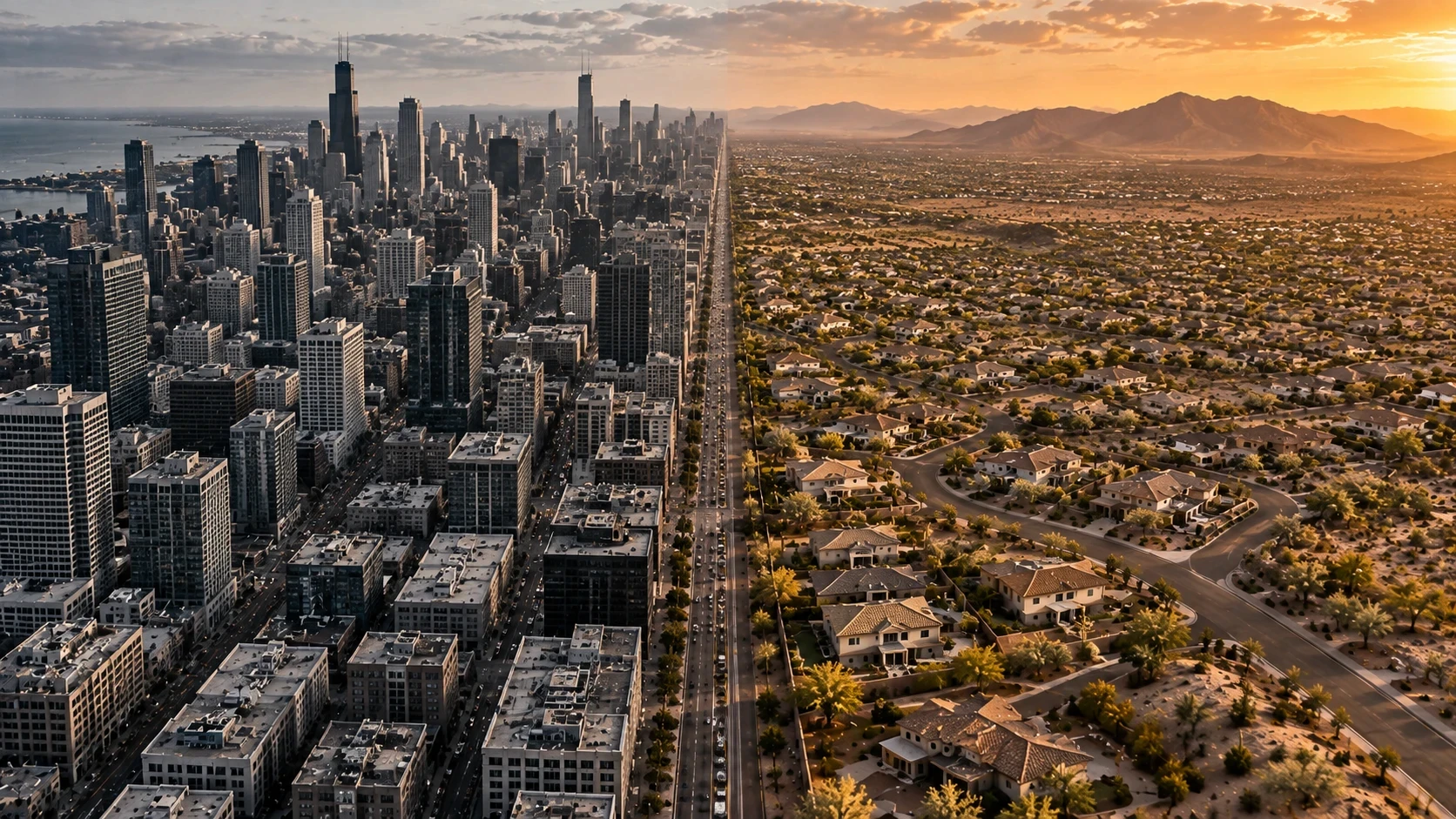
In 2012, Francis returned to Las Vegas with a thesis that most of his peers found counterintuitive. Technology was beginning to make location a choice rather than a constraint. The cities that had concentrated wealth, talent, and population for three decades were becoming less attractive on a cost-adjusted basis. The Sun Belt and Mountain West were becoming more attractive. He believed the pendulum was beginning to swing.
Twelve years later, the data has validated that thesis more completely than he expected.
The long arc of urbanisation
From roughly 1988 to 2018, the dominant narrative in American real estate was urban. Gateway cities attracted talent. They concentrated capital. They produced the intellectual and cultural output that defined the era. The suburbs were where people ended up when they could not afford the city or had decided to prioritize schools and space over proximity and energy.
That narrative shaped real estate capital allocation for thirty years. Gateway city assets commanded premium valuations. Suburban and Sun Belt markets were considered secondary at best.
Francis saw the pendulum beginning to swing before most people were willing to admit it was moving.
What Francis was watching in 2012
The thesis did not emerge from a single data point. It was the convergence of several trends Francis was tracking from his background in investment banking and urban revitalization.
First, the cost of living differential between gateway cities and their Sun Belt alternatives had reached a level that was beginning to change behavior at scale. San Francisco, New York, and Los Angeles had become genuinely unaffordable for the middle of the income distribution, not just the bottom.
Second, broadband infrastructure had matured to the point where knowledge work could be performed remotely with acceptable quality. The technical barrier to location independence was falling faster than most employers were willing to acknowledge.
Third, Francis had lived both sides of the urban-suburban experience, investment banking in major financial centers, urban revitalization work in San Francisco, and deep roots in Las Vegas. He understood what people were actually trading when they chose a gateway city versus an alternative. The trade was becoming less favorable to the cities.
COVID as an accelerant, not a cause
When COVID arrived in 2020, it accelerated the suburbanisation thesis by approximately a decade. The forced experiment in remote work proved that most knowledge work could be performed effectively outside a traditional office environment. The forced experiment in urban density proved that cities had real vulnerabilities when their amenities, restaurants, cultural institutions, and social density, were unavailable.
The population data that followed was dramatic. Las Vegas grew 21.8% in the decade to 2020. Boise grew 22%. Phoenix grew 18.8%. Salt Lake City grew 15.2%. Chicago grew 0.1%. Los Angeles was negative 0.8%.
But the important point for GMI Capital’s thesis is that these trends were visible and measurable before 2020. COVID made them undeniable. It did not create them.
What this means for bridge lending
The suburbanisation thesis is not a real estate equity thesis for GMI Capital. It is a lending thesis. It tells us where to look for borrowers who are buying, building, and repositioning assets in markets with genuine demand growth and constrained supply of quality bridge capital.
A market with 20% population growth produces sustained demand for new residential supply, retail, industrial, and mixed-use development. That development requires bridge capital. The borrowers executing that development, the developers, operators, and investors who are taking assets from one use to a higher use, need a lender who understands the local market and can close on time.
GMI Capital has been building those relationships in its five target markets since 2016. The thesis told us where to look. The relationships determine which deals we see.
The secular nature of the shift
The question GMI Capital hears most often from sophisticated investors is whether the suburban growth thesis is a temporary post-COVID phenomenon or a durable structural shift.
The evidence points to structural. The people who relocated during COVID have not returned in meaningful numbers. Remote and hybrid work arrangements have become embedded in employment contracts and workplace expectations. The cost of living differentials that made Sun Belt markets attractive have not narrowed significantly. And the infrastructure, schools, healthcare, retail, and entertainment, that makes suburban growth markets genuinely livable has continued to mature.
The pendulum that began swinging in 2012 has further to travel. GMI Capital has been in position since before most people could see it moving.
This post reflects the views of GMI Capital and does not constitute investment advice. Past performance is not indicative of future results.
The GMI Story
•
The suburbanisation thesis: what seeing the opportunity in 2012 taught us about where growth is heading
Read More
Read More

Investment Strategy
•
Why first lien position is not just a preference. It is a discipline.
Read More
Read More

Investment Strategy
•
The pessimistic lender: why looking for what can go wrong produces better returns
Read More
Read More